Two settings, two totally different jobs — and they're the easiest pair on the exam to mix up. We'll keep them separate from the very first sentence. No skipping ahead.
2 dials~9 min★ High-yield
▶ Watch · 1:54
Watch first — kVp vs mA in under two minutes.
1First — what's the deal?
Two dials, and why they get mixed up.
Every dental x-ray is set by two separate controls on the machine. One decides how strong the beam is — how hard it pushes through the tooth. The other decides how many x-rays you make. They sound similar, so students constantly swap them on the exam — and that's where easy points get lost.
kVp and mA are those two dials. Once each one has its own clear job in your head, they stop blurring together — and the questions get easy.
The whole thing in one sentence
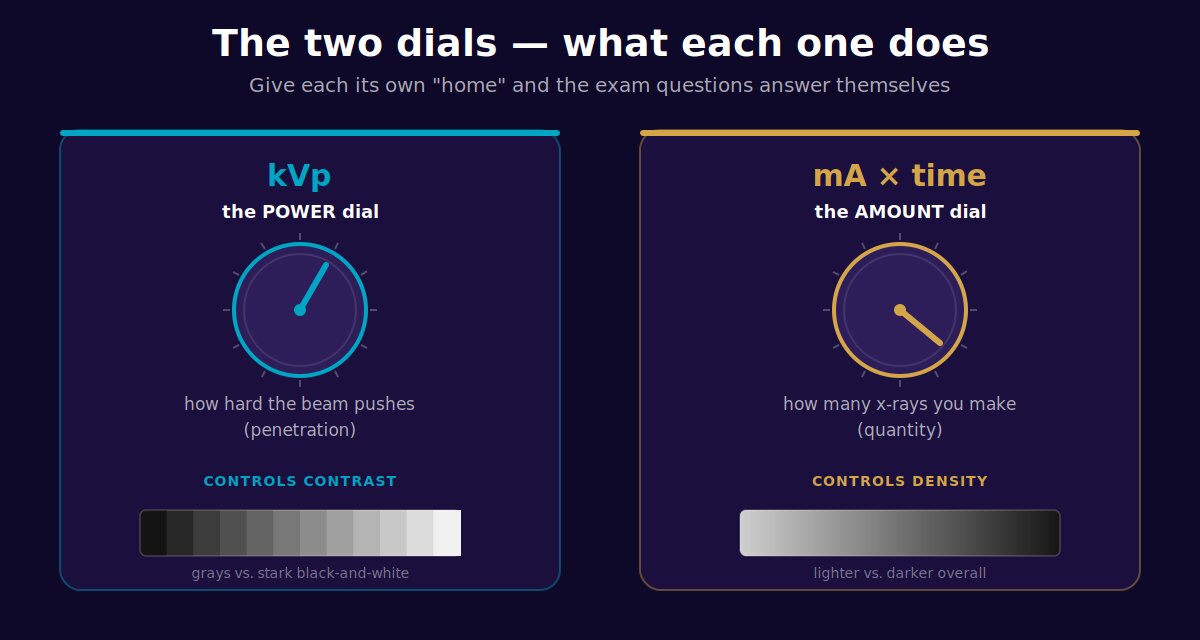
kVp is the power dial (how hard the beam pushes), and mA × time is the amount dial (how many x-rays you make).
In real terms: kVp controls penetration and contrast (gray-scale vs. black-and-white). mAs controls density (how dark the image is).
The two dials and their separate jobs: kVp = power → contrast; mA × time = amount → density. Keep these two "homes" straight and the exam questions sort themselves.
2Start here
First, forget dental words for a second.
Picture a garden hose. There are two completely separate things you can change about the water. One: how hard you crank the pressure — high pressure shoots a strong jet that punches right through a pile of leaves; low pressure just dribbles out. Two: how long you leave the hose running — that decides how much total water lands in the bucket.
🚿
Two knobs, two jobs
The pressure knob and the how-long-it-runs knob do different things. Pressure is about strength — can the water push through? Time is about amount — how much water total? An x-ray machine has these exact same two knobs, just with fancier names.
Hold that hose in your head: one knob for power, one knob for amount. That's the whole lesson. Everything else is just learning which dental word goes with which knob.
3Now the real words
Let's name the two knobs.
Each hose knob has an x-ray name. Same idea — just the words you'll see on the exam:
In plain EnglishOn the exam
💪The pressure knob (how hard the jet pushes)
→
kVpKilovoltage peak — the "push" behind the beam. Higher kVp = faster, more energetic x-rays that penetrate deeper.controls beam penetrationHow deeply the x-ray beam passes through tissue and bone before reaching the receptor. & contrastThe difference between the light and dark areas of the image — lots of distinct grays vs. mostly black-and-white.
⏱️The how-long-it-runs knob (total water)
→
mAMilliamperage — how many x-rays the tube makes each second. Think "the flow rate of the x-ray faucet." × timeExposure time in seconds. mA × time = mAs, the total quantity of x-rays.= mAsMilliampere-seconds: mA multiplied by exposure time. The single number for the total quantity of x-rays., controls densityThe overall darkness or blackness of the finished image.
💦Strong jet vs. gentle jet
→
More kVp → lower contrastmore energy = more shades of gray (long-scale contrast)
🪣A little water vs. a full bucket
→
More mAs → darker imagemore x-rays land = higher density
So in one breath: kVp is the power knob (penetration & contrast), and mAs is the amount knob (density / darkness). Hover any dotted wordLike this! Tap or hover any dotted word to see a plain-English definition. if a term slips.
4The part that feels backwards
Why more power gives you less contrast.
Everything so far makes sense — except one thing that feels wrong: turn the kVp up (more power) and the image goes flatter and grayer, not sharper. Here's the picture that fixes it for good. Think about shining a light through your hand:
Low kVp · a dim flashlight
Weak beams — too gentle to punch through dense bone.
the lightthe film
Bone stops the weak beam (stays bright white); soft tissue lets it through (goes black). Big gap → high contrast — punchy black & white.
High kVp · a blazing searchlight
Beams so strong they punch through almost everything — even bone.
the lightthe film
The strong beam blasts through both bone and tissue almost equally → they look alike → everything drifts to gray. Small gap → low contrast.
The one line to remember: weak x-rays are picky — stopped by dense, through soft, so you get stark black & white. Strong x-rays bulldoze through everything, so everything reads gray. That's why higher kVp = lower contrast. Meanwhile the other knob, mA, just adds more x-rays — the whole image gets darker, but the contrast doesn't change.
5See it happen
Turn both knobs yourself.
Here's a simulated x-ray film. Drag the blue kVp slider and watch the contrast change (punchy black-and-white vs. soft grays). Drag the gold mAs slider and watch the density change (the whole image gets darker or lighter). Two knobs, two different effects.
kVp / mAs exposure sim
Fig. 3.1 · interactive
The film — what you'd actually see
kVp · power70 kVp
mAs · amountNormal
⟵ drag either slider ⟶
Balanced settings → a diagnostic image ✓
kVp changes how punchy vs. gray it looks. mAs changes how dark it is. They don't do each other's job.
Notice the key thing: the blue knob never changes the overall darkness, and the gold knob never changes the black-vs-gray punch. Different knobs, different jobs. Now let's lock it in.
6Make it stick
kVp = the Vroom mAs = the Amount
The V in kVp stands for Vroom — power, push, penetration (and therefore contrast). The A in mAs stands for Amount — how many x-rays total, which sets density. V = power, A = amount. Two letters, two jobs, never mixed up again.
You just learned it the long way. Here's the one-screen version to scan before test day.
Turn kVp up → contrast down
Low kVp · high contrast
Balanced
High kVp · low contrast
The V knob
kVp = ContrastV for Vroom · the gray scale
The A knob
mAs = DensityA for Amount · overall darkness
Exam cue
Question names an effect? Match it: contrast / penetration → kVp. density / darkness → mAs.
V for Vroom · A for Amount
8Beat the exam
How DANB will actually ask this.
The exam loves to test whether you can keep these two straight. It'll name an effect (contrast or density) and ask which factor controls it — or it'll change one setting and ask what happens. Here's the cheat-pattern:
"controls contrast / scale of contrast"→kVp
"controls density / image darkness"→mA / mAs
"controls beam penetration"→kVp
"quantity / number of x-rays"→mA / mAs
"image too light — make it darker"→Increase mAs
9Check yourself
Which exposure factor is primarily responsible for controlling the density (overall darkness) of a dental radiograph?
Milliampere-seconds (mAs). mAs sets the amount of x-rays — the "A for Amount" knob — which controls density. kVp is the power knob (contrast).
9One more
An operator increases the kVp while keeping mAs the same. The resulting image will most likely show:
Lower contrast (more shades of gray). Raising kVp gives the beam more "Vroom" — it penetrates more and produces a longer scale of contrast, meaning more grays.
9Lock it in
A radiograph appears too light overall, but contrast looks fine. The best correction on the retake is to:
Increase the mAs. "Too light / too dark" is a density problem, and density is the mAs (amount) knob. Leave kVp alone since contrast is fine.
That's the whole thing. On test day, you won't reason it out — you'll just know.
When a question names an effect — contrast or density — or changes one dial, you'll read the answer straight off two letters: V for Vroom, A for Amount. That's mastery, not memorization.