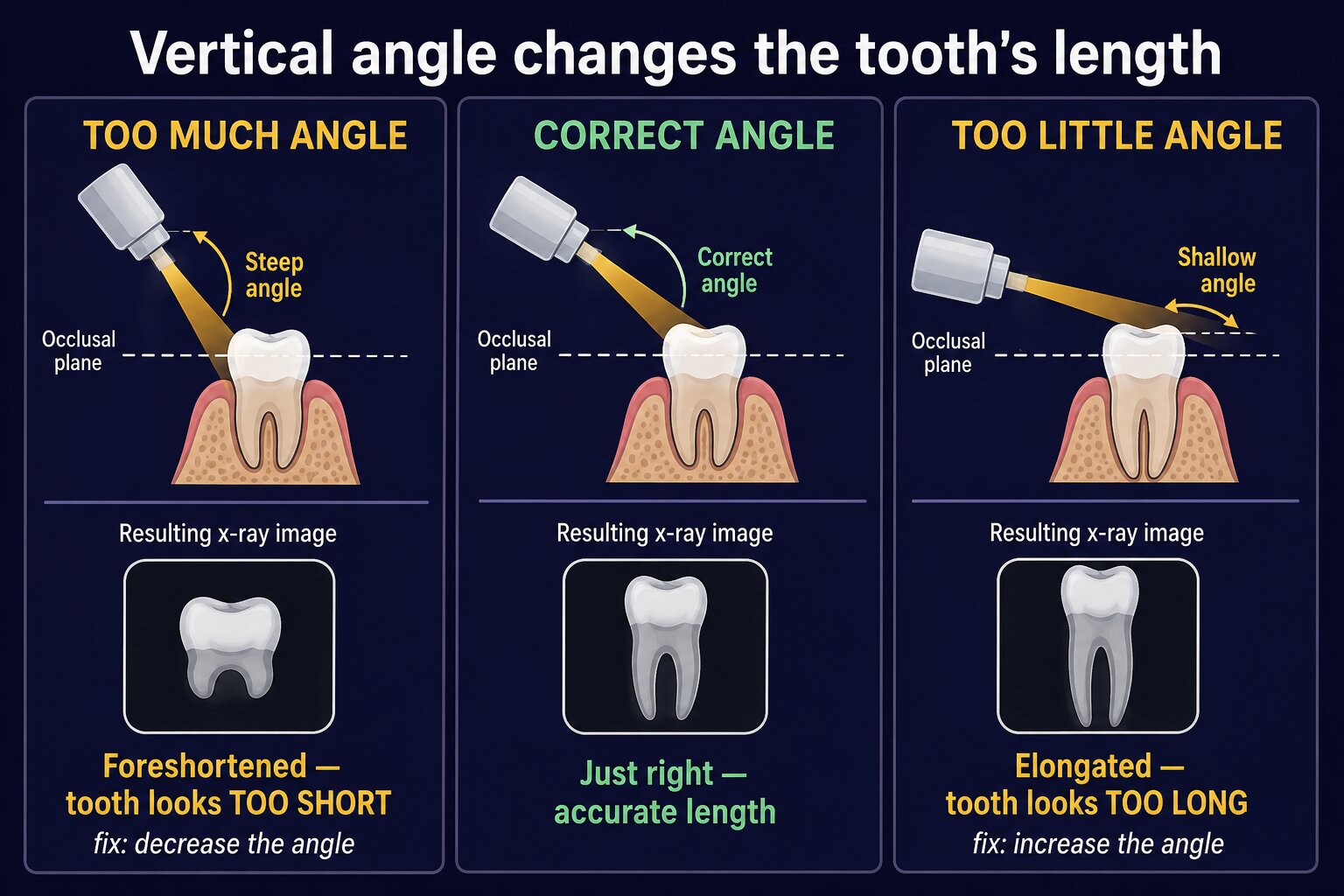
Tilt the beam wrong and the tooth comes out too short or too long — even though the real tooth is perfectly fine. Here's the whole thing, at a glance.
~5 min9 cards★ Most-missed on the RHS exam
▶ Watch · 1:42
Watch first — why the wrong tilt makes a fine tooth look too short or too long, in under two minutes.
1See the difference
Same tooth, three beam angles.
Steep beam → foreshortened (too short); flat beam → elongated (too long). The fix is always the opposite of the problem.
Too much angle
Foreshortened — too short
Fix: decrease the angle
Correct angle
Accurate length
Apex & bone visible
Too little angle
Elongated — too long
Fix: increase the angle
2The one idea
It's a shadow, not a photo.
An x-ray image is the tooth's shadow cast onto the sensor. Like a shadow puppet: tilt the light and the same hand throws a longer or shorter shadow — the hand never changed.
● steep beam● flat beam
3Now the real words
Same idea, dental vocabulary.
Everything in the flashlight picture has a dental name — here's the translation, since these are the exact words the exam uses:
In plain EnglishOn the exam
🔦The flashlight
→
The x-ray beamaimed by the PIDPosition Indicating Device — the cone-shaped tube on the x-ray machine that points the beam.
🧱The wall
→
The receptorThe digital sensor (or PSP plate) inside the mouth that captures the image — the "wall" the shadow lands on.where the shadow lands
✋Your hand
→
The tooththe thing casting the shadow
🔄Tilting up/down
→
Vertical angulationHow far up or down the beam is tilted. "Vertical" = the up-and-down aim.up-and-down aim of the beam
4Never mix them up
The word tells you.
foreSHORTened = too much tilt
"Foreshortened" literally has SHORT in it. Short shadow = too much angle. So the other is automatic: elongated (long) = too little angle.
🌅
Your own shadow: at noon the sun is high (steep) → shadow short. At sunset the sun is low (flat) → shadow long. The beam works the same way.
5Try it yourself
Move the beam and watch the shadow.
The tooth never changes size — only the shadow on the sensor does
steep tiltflat tilt
Beam at the ideal angle → the shadow matches the tooth's true length ✓
6Spot it on the exam
DANB describes the problem — you name the cause.
"teeth look short / stubby / foreshortened"→too MUCH vertical angulation
"teeth look long / stretched / elongated"→too LITTLE vertical angulation
"how do I fix foreshortened teeth?"→decrease the vertical angle
"how do I fix elongated teeth?"→increase the vertical angle
7Check yourself
Teeth appear shortened (foreshortened). Most likely cause?
Excessive vertical angulation. Short = "foreSHORTened" = too much angle.
7Check yourself
Teeth appear longer than actual. What fixes it on the retake?
Increase the vertical angulation. Elongated = too little angle, so add more.
Recap
The whole thing in 4 lines.
✓An x-ray image is a shadow, not a photo — so the beam's angle changes its size.
✓Vertical angulation = how far up/down the beam is tilted.
✓Too much tilt → short (foreSHORTened). Too little → long (elongated).
✓Exam asks the cause of a problem: short = too much, long = too little.
That's the whole idea. On test day, you won't reason it out — you'll just know.
Short means too much tilt, long means too little — and the fix is always the opposite of the problem. When a question describes a stubby or stretched tooth, you'll read the answer straight off the word itself.